This is a Member of Parliament appointed by government or the Opposition side or political party from among its members in Parliament to ensure discipline, due attendance, participation in proceedings and voting in Parliament by its members.
Parliament has government, opposition and party whips.
Whips have also been mandated to designate members to serve on committees.
The term "Stranger" is given to all persons other than the President of Uganda, Vice President, Speaker, ministers and ministers of state, MPs and staff of the House/Parliament.
Non MPs can visit Parliament for a tour of the Building or to attend plenary or committee sessions.
Admission to Parliament is free to the public, institutions, tourists and other individuals and groups.
Anyone wishing to visit Parliament ordinarily/formally presents a written request to the Clerk to Parliament who will delegate the Department of Communication and Public Affairs, which will advise them on the best time to visit and other requirements needed.
Visitors to Parliament should ensure that they are dressed decently.
Section 5 of the Parliament (Powers and Privileges) Act says, “No stranger shall be entitled as a right to enter or to remain within the precincts of the Assembly.” The same Act prohibits strangers from getting into the public galleries with a briefcase, camera, tape recorder, transistor radio, a mobile telephone or any electronic device. Firearms must also be surrendered to security officers at the entrance. In addition, while in the galleries, strangers are not permitted to smoke, read a book or newspaper.
Committees of Parliament ordinarily sit starting at 10.00a.m. on Tuesday, Wednesday and Thursday. The sittings will have to be adjourned to allow members attend the plenary that sits starting at 2.00p.m. on those days.
However, some committees may schedule meetings on Monday and Friday as well. In addition, committees may schedule field trips, which could include sittings outside their normal schedules and may include weekends.
Plenary ordinarily sits in the Parliament Chamber at Parliament House and in other places/venue as the Speaker may designate.
The Plenary ordinarily sits starting at 2.00p.m. to 7.00p.m. on Tuesday, Wednesday and Thursday.
Parliament Rules however, permit the Speaker to adjust the time and days of sitting of the House beyond what is ordinarily allowed especially considering the business before it.
The foundation stone for the Parliament Building was laid on 18 December 1956, by the then Governor of Uganda, Sir Andrew Cohen.
Construction of the main building commenced in 1958. On 05 October 1962 the then Prime Minster, Dr Apollo Milton Obote, laid the foundation stone for the Independence Arch, at the entrance to the Parliament Building.
The current 11th Parliament as at 03 May 2023 comprises of:
Constituency Representatives - 352
District Woman Representatives - 146
Uganda Peoples' Defence Forces' Representatives - 10
Youth Representatives - 5
Persons with Disabilities (PWDs) Representatives - 5
Workers' Representatives - 5
Older Persons' Representatives - 5
Ex Officio Members - 28
TOTAL: 556 MEMBERS
Parliament is presided over by the Speaker, and in her absence, the Deputy Speaker both of whom are elected by Members of Parliament from their number.
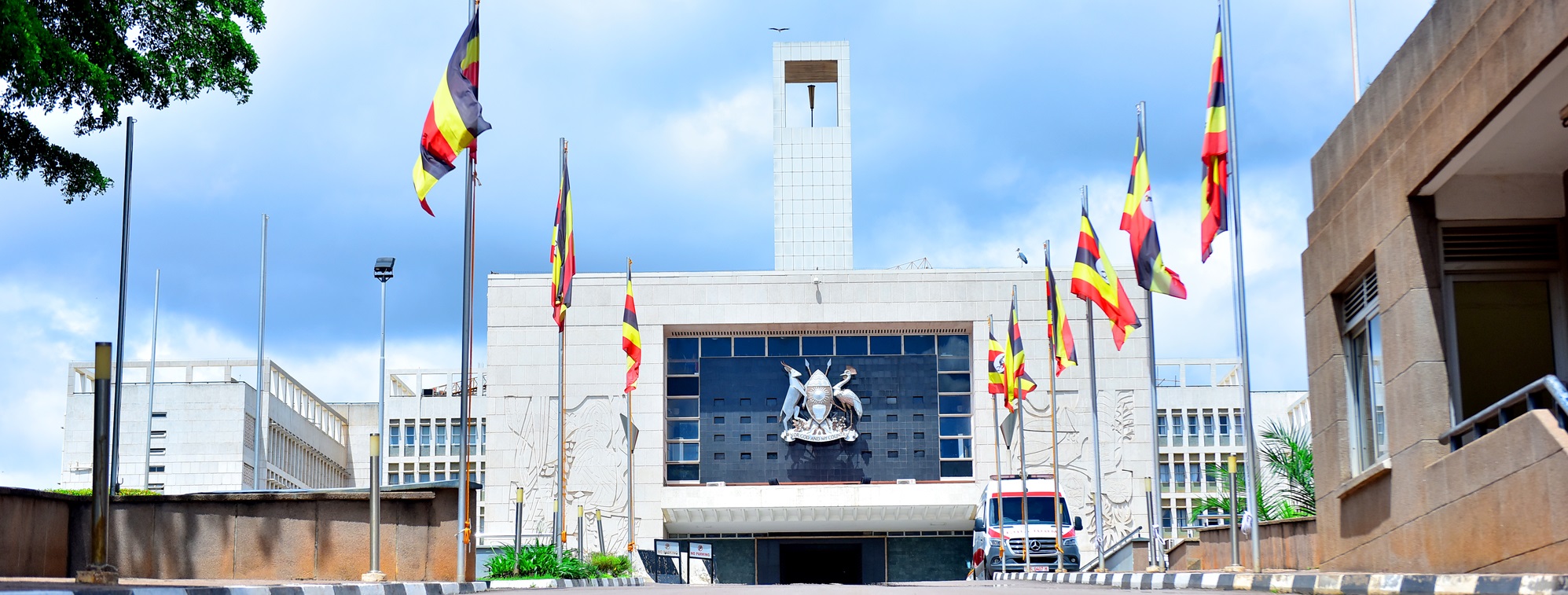
Parliament House is located on Plot 16-18, Parliament Avenue and Plot 13-15, Sir Apollo Kaggwa Road, in the administrative centre of the capital, Kampala.
The Parliament is the national legislative body where elected and appointed members from all over the country meet to draft, debate and pass laws/legislation through which the institutions of government endeavour to guide the country’ s progress.
It derives its roles/functions from Chapter Six (6) of the Constitution of the Republic of Uganda. The establishment, composition and functions of Parliament are derived from the Constitution of the Republic of Uganda. Article 77 (1) states that “there shall be a Parliament of Uganda.” Parliament conducts its business in both plenary and committees.
Parliament elects Uganda’s representatives to the East African Legislative Assembly and the Pan-African Parliament.
The East African Legislative Assembly is the legislative organ of the East African Community and consists of members elected from outside the national Parliaments of the partner states.
Uganda’s nine representatives to the Assembly include:
- Hon. Rose Akol Okullu (National Resistance Movement)
- Hon. Paul Mwasa Musamali (National Resistance Movement)
- Hon. George Stephen Odongo (National Resistance Movement)
- Hon. James Kakooza (National Resistance Movement)
- Hon. Mary Mugyenyi (National Resistance Movement)
- Hon. Dennis Namara (National Resistance Movement)
- Hon. Gerald Blacks Siranda (Democratic Party)
- Hon. Jacquiline Amongin (Independent)
- Hon. Veronica Babirye Kadogo (Independent)
The Pan-African Parliament represents all the people of Africa with the aim of evolving into an institution with full legislative powers, whose members are elected by universal adult suffrage.
The sittings of the Parliament are held in Midrand, South Africa. Members of Parliament elect five of its own to represent the country at the Pan-African Parliament.
The current members include:
- Hon. Felix Okot Ogong (National Resistance Movement)
- Hon. Juliet Achayo Lodou (National Resistance Movement)
- Hon. Eric Musana (National Resistance Movement)
- Hon. Caroline Kamusiime (National Resistance Movement)
- Hon. Patrick Nsamba Oshabe (INational Unity Platform)